If you're not an athlete or serious exerciser — and you just want to
work out for your health or to fit in your clothes better — the gym
scene can be intimidating and overwhelming. What are the best exercises
for me? How will I find the time?
Just having to walk by treadmills, stationary bikes, and weight
machines can be enough to make you head straight back home to the couch.
Yet some of the best physical activities for your body don't require
the gym or ask you to get fit enough to run a marathon. These "workouts"
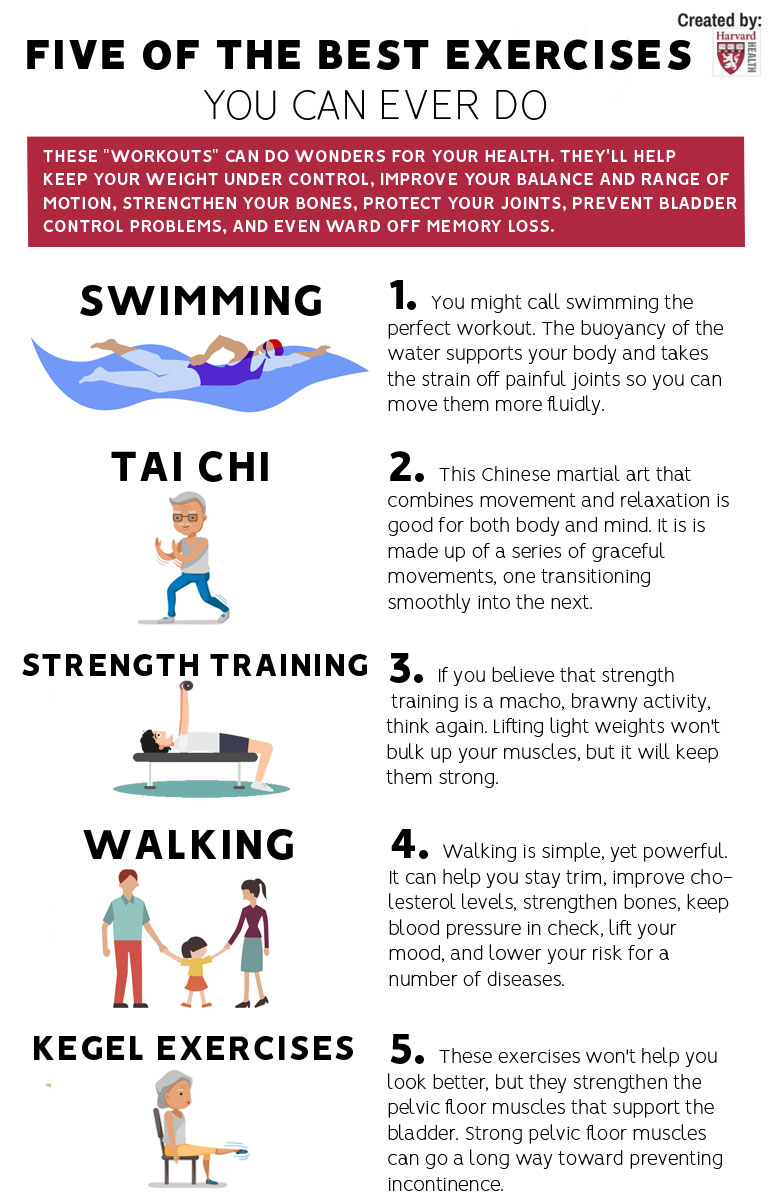
can do wonders for your health. They'll help keep your weight under
control, improve your balance and range of motion, strengthen your
bones, protect your joints, prevent bladder control problems, and even
ward off memory loss.
No matter your age or fitness level, these activities are some of the
best exercises you can do and will help you get in shape and lower your
risk for disease:
1. Swimming
You might call swimming the perfect workout. The buoyancy of the
water supports your body and takes the strain off painful joints so you
can move them more fluidly. "Swimming is good for individuals with
arthritis because it's less weight-bearing," explains Dr. I-Min Lee,
professor of medicine at Harvard Medical School.
Research has found that swimming can also improve your mental state
and put you in a better mood. Water aerobics is another option. These
classes help you burn calories and tone up.
2. Tai chi
This Chinese martial art that combines movement and relaxation is
good for both body and mind. In fact, it's been called "meditation in
motion."
Tai chi
is made up of a series of graceful movements, one transitioning
smoothly into the next. Because the classes are offered at various
levels, tai chi is accessible — and valuable — for people of all ages
and fitness levels. "It's particularly good for older people because
balance is an important component of fitness, and balance is something
we lose as we get older," Dr. Lee says.
Take a class to help you get started and learn the proper form. You
can find tai chi programs at your local YMCA, health club, community
center, or senior center.
3. Strength training
If you believe that
strength training
is a macho, brawny activity, think again. Lifting light weights won't
bulk up your muscles, but it will keep them strong. "If you don't use
muscles, they will lose their strength over time," Dr. Lee says.
Muscle also helps burn calories. "The more muscle you have, the more
calories you burn, so it's easier to maintain your weight," says Dr.
Lee. Similar to other exercise, strength training may also help preserve
brain function in later years.
Before starting a weight training program, be sure to learn the
proper form. Start light, with just one or two pounds. You should be
able to lift the weights 10 times with ease. After a couple of weeks,
increase that by a pound or two. If you can easily lift the weights
through the entire range of motion more than 12 times, move up to
slightly heavier weight.
4. Walking
Walking is simple, yet powerful. It can help you stay trim, improve
cholesterol levels, strengthen bones, keep blood pressure in check, lift
your mood, and lower your risk for a number of diseases (diabetes and
heart disease, for example). A number of studies have shown that walking
and other physical activities can even improve memory and resist
age-related memory loss.
All you need is a well-fitting and supportive pair of shoes. Start
with walking for about 10 to15 minutes at a time. Over time, you can
start to walk farther and faster, until you're walking for 30 to 60
minutes on most days of the week.
5. Kegel exercises
These exercises won't help you look better, but they do something
just as important — strengthen the pelvic floor muscles that support the
bladder. Strong pelvic floor muscles can go a long way toward
preventing incontinence. While many women are familiar with Kegels,
these exercises can benefit men too.
To do a Kegel exercise correctly, squeeze the muscles you would use
to prevent yourself from passing urine or gas. Hold the contraction for
two or three seconds, then release. Make sure to completely relax your
pelvic floor muscles after the contraction. Repeat 10 times. Try to do
four to five sets a day.
Many of the things we do for fun (and work) count as exercise. Raking
the yard counts as physical activity. So does ballroom dancing and
playing with your kids or grandkids. As long as you're doing some form
of aerobic exercise for at least 30 minutes a day, and you include two
days of strength training a week, you can consider yourself an "active"
person.
 For additional information on this and other questions about getting started on a healthy exercise program, read Starting to Exercise, a Special Health Report from Harvard Medical School.
Labels: bai-tap